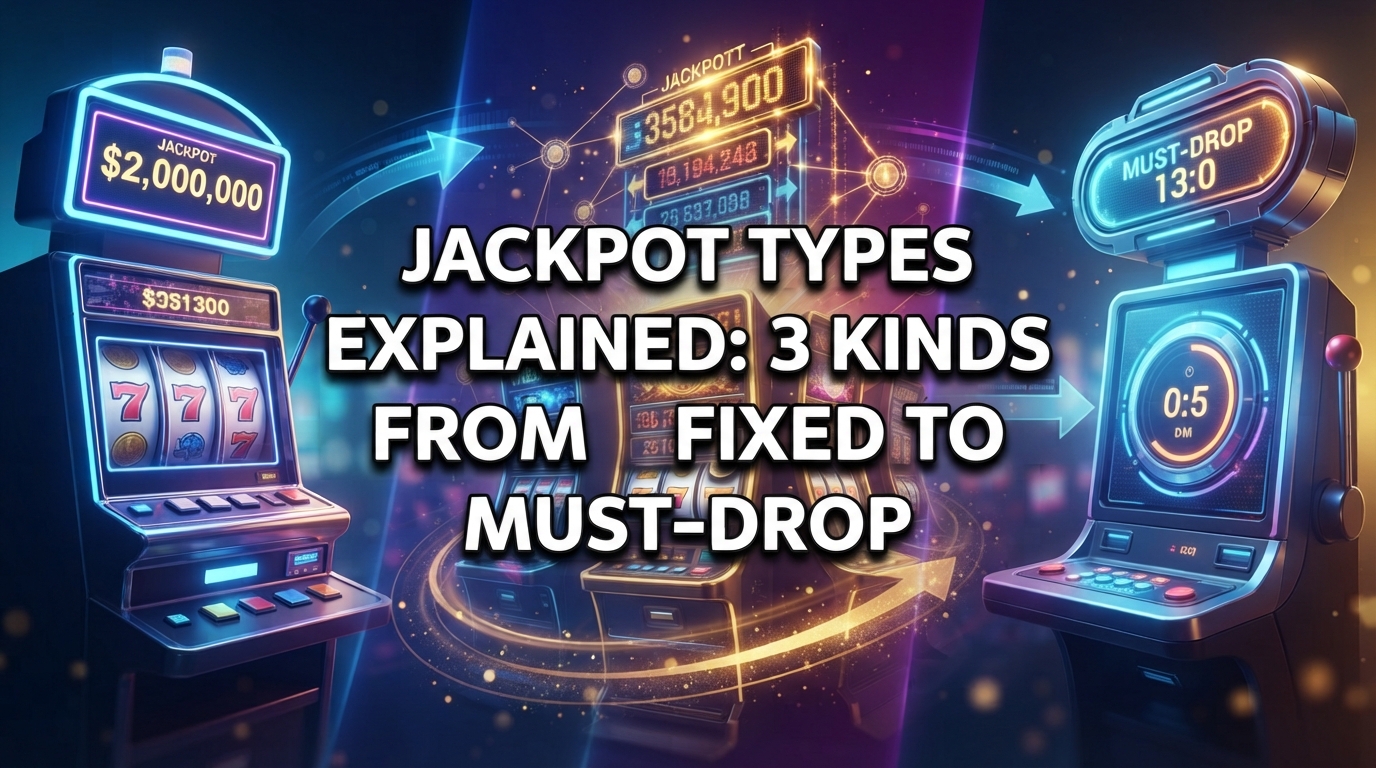
A jackpot is the headline prize that draws players to reel games more than anything else, yet in 2026 these prizes come in several forms that work very differently. This guide explains how fixed, progressive and must-drop jackpots differ, covering how each prize builds, what triggers a payout and what it means for players, based on rules published by the studios.
Key Takeaways
- A fixed prize has a set value that does not grow with the number of players
- A progressive jackpot grows from a slice of every stake placed and resets to a seed value after it pays
- A must-drop system is a progressive that must pay before reaching a cap or before a deadline
- The bigger the prize, the rarer it is, and the contribution to the pool usually comes out of the base game’s returns
- No time of day guarantees that any individual player will be the winner
What a Jackpot Is
It is a special prize above the regular paytable wins. It is usually triggered by landing a full set of symbols, entering a jackpot wheel feature or at random on any spin. Some games include several tiers in one title, such as Mini, Minor, Major and Mega, with the small tiers paying far more often than the big ones.
These prizes look similar across games, with a large prize figure displayed on screen, but the mechanics behind them fall into three main types. Those differences affect prize size, how often the prize pays and the overall return of the game.
Fixed Jackpots: A Set Prize
A fixed prize has a predetermined value. Some games set it as a specific amount, while others set it as a multiple of the stake per spin. The value never grows no matter how many people play, and it does not reset after someone wins.
The advantage is transparency. Players know the top prize from the start, and the game does not divert part of each stake into a shared pool, so more of its return sits in regular wins. The drawback is that the top prize is usually far smaller than a progressive pool.
Progressive Jackpots: A Prize That Keeps Growing
A progressive jackpot grows every time someone plays, with a small share of each stake added to the pool. When someone wins, the pool resets to a predetermined seed value rather than zero and starts building again.
Progressive pools differ by how widely they are linked. Some are tied to a single game, some are shared across one operator’s site, and others form networks spanning many sites worldwide. Networked pools grow fastest. The best-known example is the Mega Moolah network, which paid a UK player around 13.2 million pounds in 2015 from a 25-pence spin.
The key point is that a growing pool has no deadline. It can build for months before anyone wins, and the share taken for the pool usually lowers the return from the game’s regular prizes.
Must-Drop Jackpots: Progressives With a Guarantee
A must-drop prize is a progressive with a rule that forces it to pay before it reaches a set cap or before a set time runs out. In some systems, the exact value at which it will pay is drawn at random right after the previous win, somewhere within the range below the cap.
The most widespread example is Red Tiger’s Daily Drop network, which features an hourly prize that must pay within 60 minutes, a daily prize that must pay before 23:00 UK time, and a larger top tier with no fixed deadline. Other studios run similar systems, such as Relax Gaming’s Dream Drop, whose Mega tier must pay before hitting its cap.
The appeal of a must-drop system is knowing someone will win within the published window. However, each player is still just one of many competing for it, so a prize that must drop does not mean the person playing at that moment will be the one to collect.
Common Jackpot Myths
A common belief is that a progressive prize that has not paid in a long time is due to drop soon. That is not true for open-ended pools without a cap, because every spin is independent. With a capped must-drop system, the chance of a payout does rise as the cap or deadline approaches, but more players pile in at exactly that moment, so each person’s individual chance is not as high as it feels.
The 3 Jackpot Types Compared
| Type | Value | When it pays | Main appeal |
|---|---|---|---|
| Fixed | Set amount | Symbol or in-game condition | Predictable |
| Progressive | Keeps growing | No deadline | Very large top prize |
| Must-drop | Grows up to a cap | Before the cap or deadline | Guaranteed winner in the window |
How a Jackpot Affects RTP
In games with a growing prize pool, the advertised RTP usually includes the share that feeds the pool. Take that share out, and the return from regular wins is lower than in a comparable game without one. Players who never land the big prize may therefore feel such games pay less during normal play than fixed-prize titles.
Some jackpot slot games also give higher stakes a better chance of entering the bonus feature, and some classic titles only make the top prize available at the maximum stake. These details are listed on the game’s rules page, so read it before you start.
What to Know Before Choosing a Jackpot Game
Match the type to your goal. If you want returns spread evenly, a fixed prize suits you better. If you want a shot at a life-changing sum, accept that the odds are extremely low. If you like clear payout conditions, must-drop systems are the most transparent.
Most importantly, never raise your stake just because a prize figure looks high or close to its cap. Set a daily budget in advance and treat any big prize as a bonus thrill rather than a target to chase. Every round remains random and independent.
Disclaimer: This article is for informational purposes only and is not an encouragement to play. If you feel your play is getting out of control.